Why Retrieval Systems Rot
Part 20: Why retrieval quality falls after launch while every operational metric stays green, with implementations
Recap
In Part 19, we measured how much recall approximate search gives up once 10 million passage embeddings no longer fit in memory.
 Avi Chawla
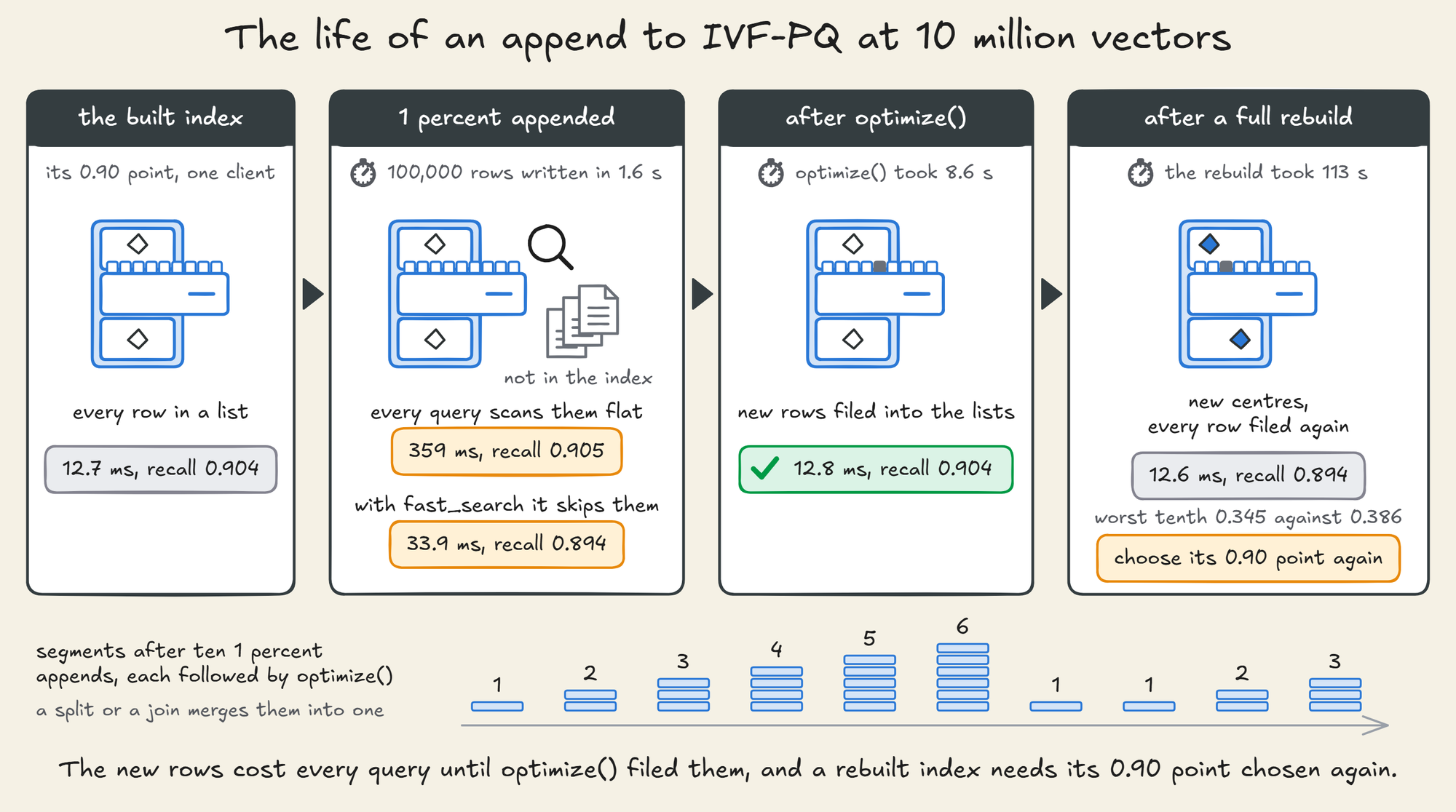
Tuned to find 9 of the true top 10 on average, every design answered in 2.5 to 25.0 ms at the median with the full vectors on disk, as long as its index fitted in its cache.
LanceDB's default query fell short of the true top 10 on every index, finding between 0.589 and 0.903 of it depending on the design.
A 1 percent append made IVF-PQ's queries 28 times slower until optimize() indexed the new rows.
Part 19 closed on what a new model needs from an index: every passage embedded again, and a second index built beside the first while the old one keeps serving.
Every vector in Part 19 came from one model, embedded once, from documents that were never revised.
When document updates are put off, the index drifts from the documents it serves.
This part measures what that drift does to retrieval quality, on a million Wikipedia passages with two revisions of every changed page and two generations of IBM's Granite embedding models:
- What a half-finished model upgrade shows on latency, errors and the launch evaluation, and how soon.
- How often an outdated revision outranks its replacement, with and without a reranker.
- What catches a mixed index, and how to switch to a new one with no wrong-model answers.
- What re-embedding costs, and whether an adapter can put it off.
You can run all of it yourself from the code in the zip.
We moved the ingest pipeline to the new model and left the queries on the old one. From the first month on, no question about a changed fact got the passage holding its current answer back in its top 10.
No request failed, and after its first minute under load, the mixed index answered as fast as the clean one.
Both indexes below hold December's passages. The launch evaluation is the test set built at launch, and the targeted evaluation asks only about facts that changed:
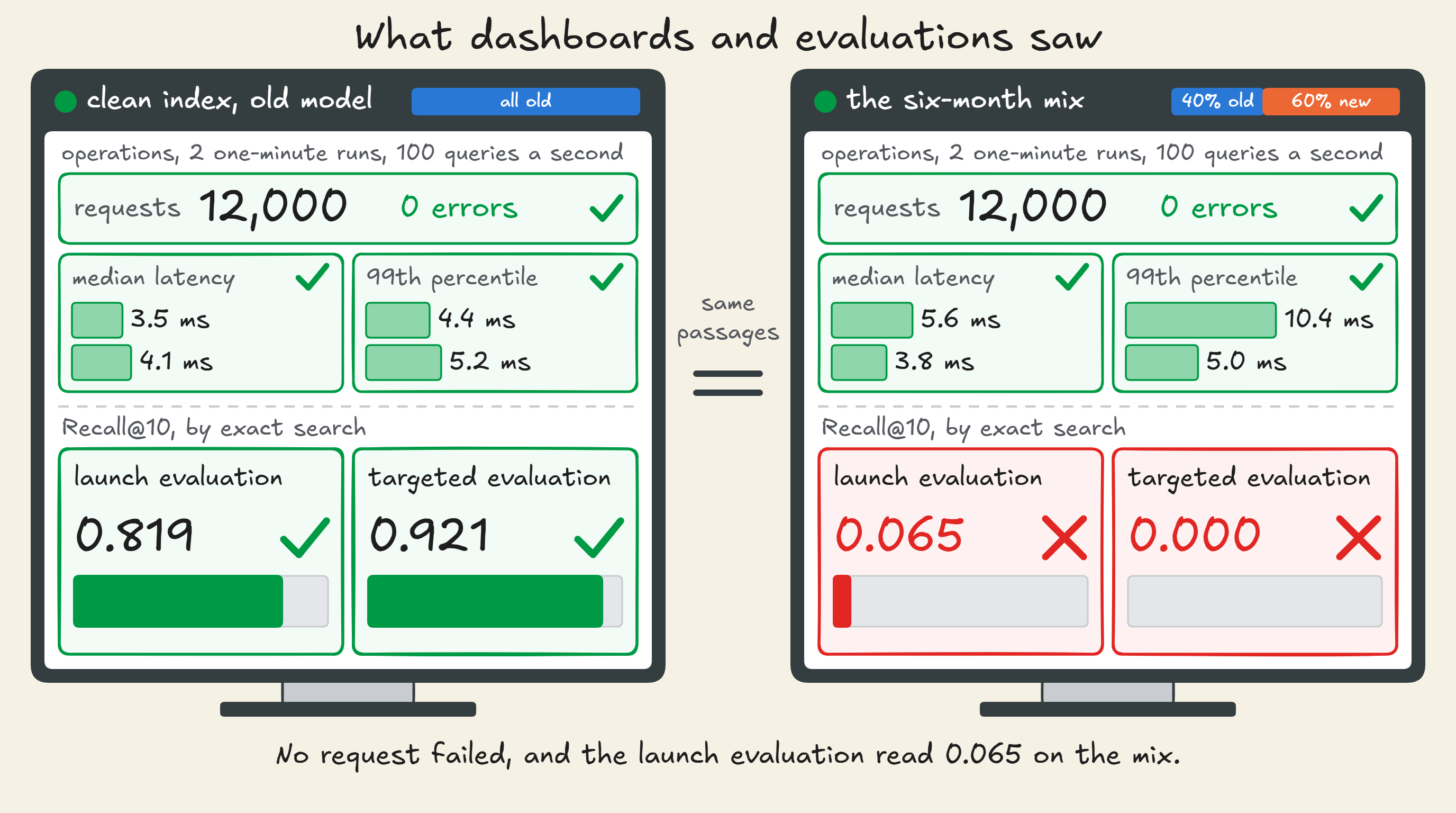
Run every week, the launch evaluation of 1,544 questions noticed this mix in week 1.
Its questions cannot show an outdated revision ranked above the current one, and that takes a second evaluation, of changed facts. The check that stops the mix on writes costs 0.112 µs per point.
What moves after launch
Keeping a retrieval system going means re-embedding on each data change, tuning chunking, debugging the misses and running the store.
The corpus, the embedding model and the questions users ask are all known on launch day, and all three move after it:
- Documents are revised. Of 2,000 Wikipedia pages drawn at random, 1,111 were edited at least once in the six months after our launch date of 1 June 2024.
- The embedding model is replaced, because a newer one retrieves better or because the old one stops being served. IBM names
granite-embedding-small-english-r2as the replacement forgranite-embedding-30m-english, and those are our two models. - The questions drift towards things the evaluation set never covered.
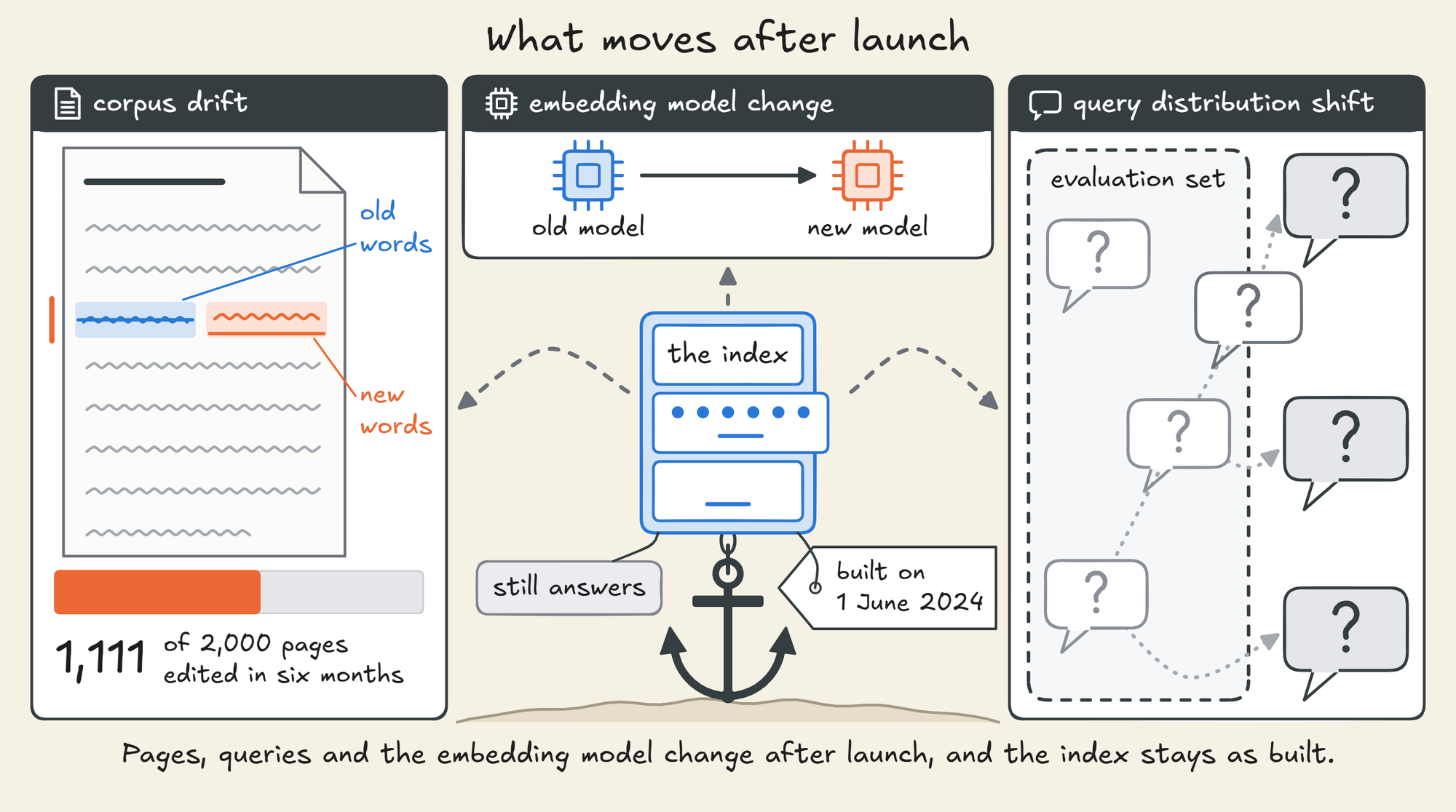
None of the three drifts raises an error. The store returns ten results in a few milliseconds, whether or not the right passage is among them.
They share that symptom, worse answers while every operational metric stays green, so they are easy to confuse. They differ in what detects each one and what fixes it, and the sections below build up every term in this table:
| Drift | What moves | What detects it | What fixes it | Measured in |
|---|---|---|---|---|
| Corpus drift | pages are revised, and old revisions stay in the index | an evaluation of facts that changed | supersession or stable ids, and in part recency weighting | Experiment 2 |
| Embedding model change | new vectors come from a different model from the old ones | stamps checked on writes and queries, and both evaluations run on a schedule | a gated blue-green re-embed (an adapter fell short here) | Experiments 1, 3, 4 and 5 |
| Query distribution shift | users ask about things the evaluation set never covered | comparing live queries with the evaluation set | refreshing the evaluation set from live traffic | not measured here, with live sampling in Part 22 |
Similarity has no sense of time
Take a page that changes. A city's population is updated, or a company names a new chief executive. The new revision keeps almost every sentence of the old one and changes a few words.
We index pages in blocks of 100 words. Call the block holding the new fact the current block, and the block holding the old fact its outdated twin.
Embedded, two blocks that differ in a few words can land close together. A question about the fact is close to both, and nothing in either vector says which one is current:
Who is the current kit supplier of Derry City F.C.?
Outdated revision, July 2024
Derry have had various kit suppliers, including Adidas, Avec, Erreà, Fila, Le Coq Sportif, Matchwinner, Umbro, Spall O'Neills, Hummel, and, currently, Adidas.
Current revision, August 2024
Derry have had various kit suppliers, including Adidas, Avec, Erreà, Fila, Le Coq Sportif, Matchwinner, Umbro, Spall O'Neills, Hummel, and, currently, O'Neills.
| Rank in the top 10 (similarity) | Old model | New model |
|---|---|---|
| Outdated revision | 2nd (0.844) | 1st (0.879) |
| Current revision | 1st (0.846) | 2nd (0.879) |
Changed fact 1 of 12. Text from the Wikipedia article "Derry City F.C." by Wikipedia contributors (the two revisions), CC BY-SA 4.0. The question is from HoH-QAs.
The words that changed are in bold. The facts are drawn at random, with a fixed seed, from the test questions where both revisions reached both models' top 10 and each answer sits in one short, intact sentence inside its block.
Among the test questions where either block reached the top 10, dense search ranked the current one higher in 50.5 percent of them with the old model, and in 51.0 percent with the new one.
Whichever model embeds them, the order is close to a coin flip. It comes from small differences in wording, and the date of each plays no part.
Over the full corpus, the old model's MRR@10 was 0.759 with the current revision alone and 0.557 with both, because the old revision's blocks moved above the current block.
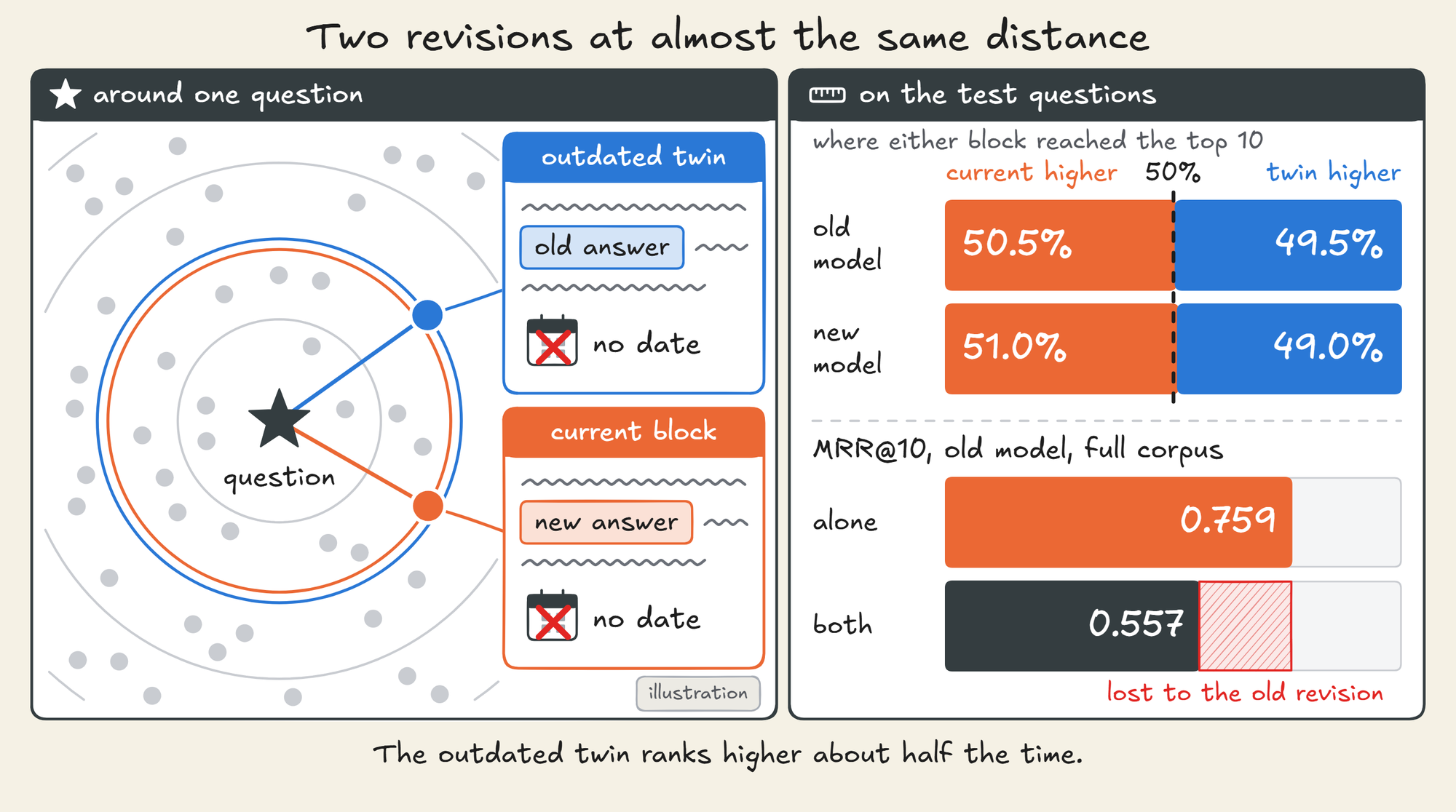
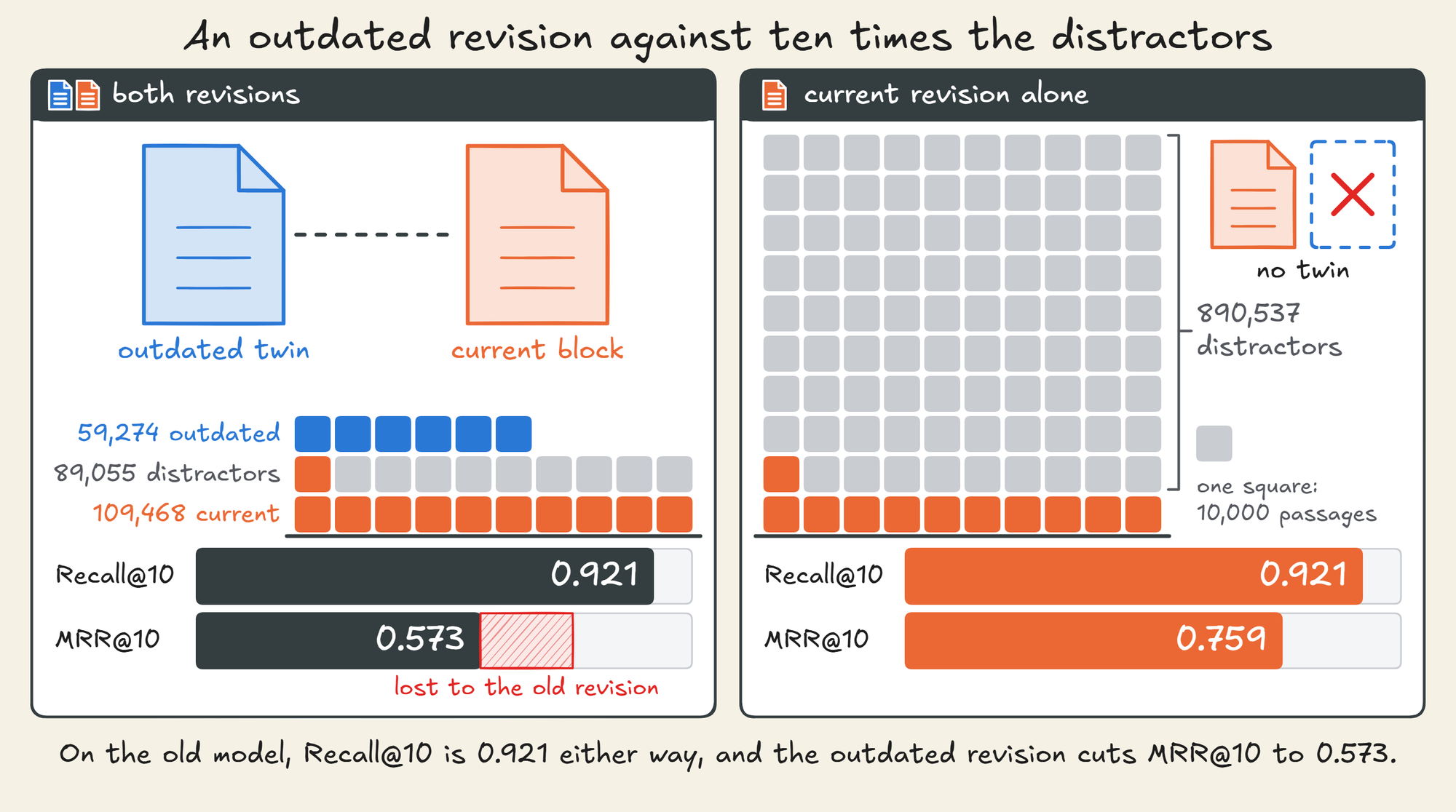
An outdated revision also does more harm than ten times as many distractor passages.
On the old model, we indexed both revisions with a tenth of the distractor passages, 89,055, and then the current revision alone with all 890,537. Both read a Recall@10 of 0.921. MRR@10 was 0.573 with the old revision in and 0.759 without it:
The natural repair is a reranker. A cross-encoder reads the question and each passage together, so it can weigh the words that a single vector compresses away.
FRESCO, a benchmark in the Findings of EMNLP 2026, tested 19 rerankers on this conflict. It found "a strong bias toward older, semantically rich documents, even when they are factually obsolete".
On our corpus, IBM's Granite reranker and mixedbread's mxbai-rerank-base-v1 lifted recall without settling the order. They stayed near the same coin flip, and Experiment 2 shows why.
Giving the score a date, or taking the old revision out of the index, did move the order.
All of this happens inside one model's vectors. An upgrade adds a second model.
Two models in one index
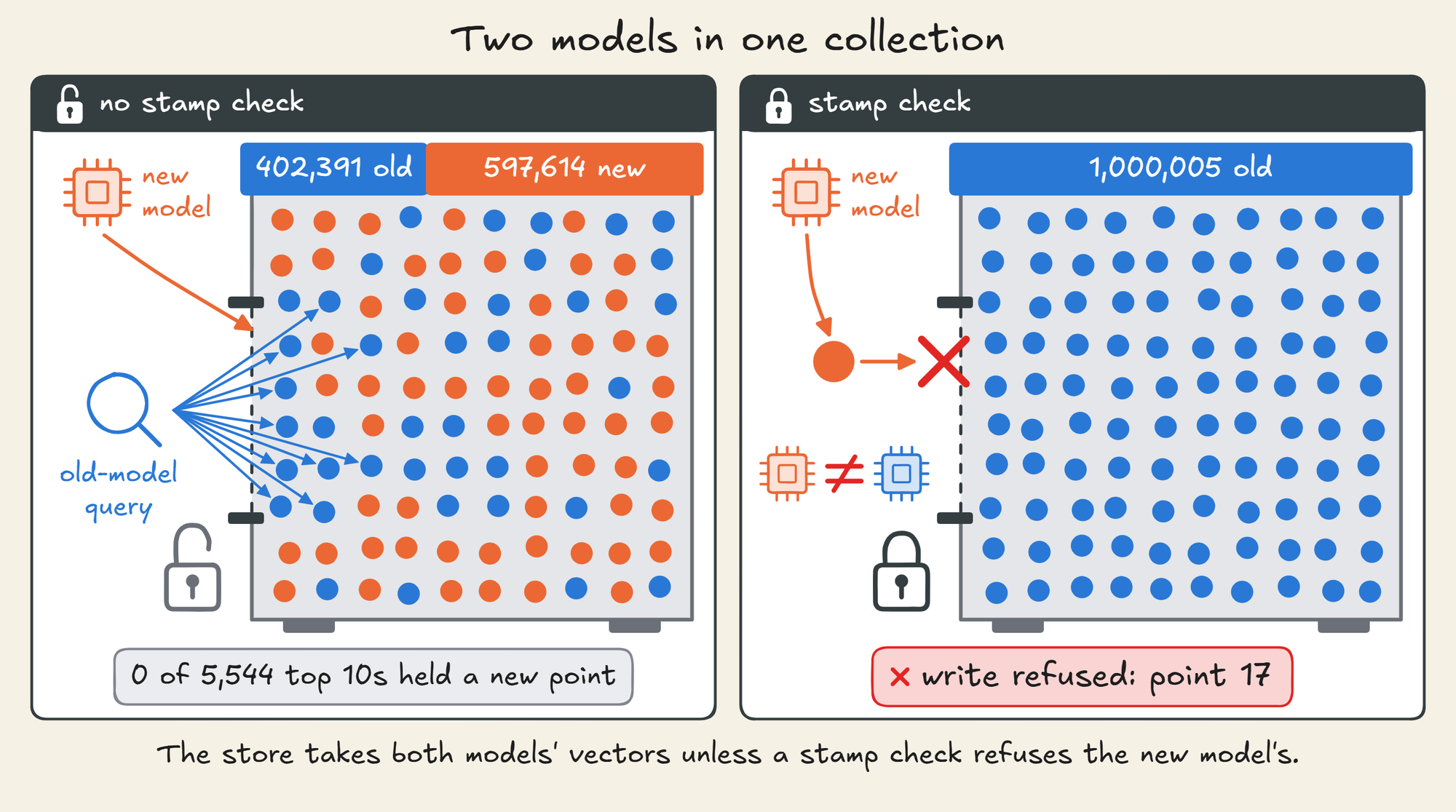
Both models here produce 384 numbers per passage, so a vector from the new model fits a collection built for the old one, and the store accepts it without complaint.
The scores that come back are well formed and meaningless.
Each model learns its own coordinates, so a dot product across the two compares coordinates that were never aligned.
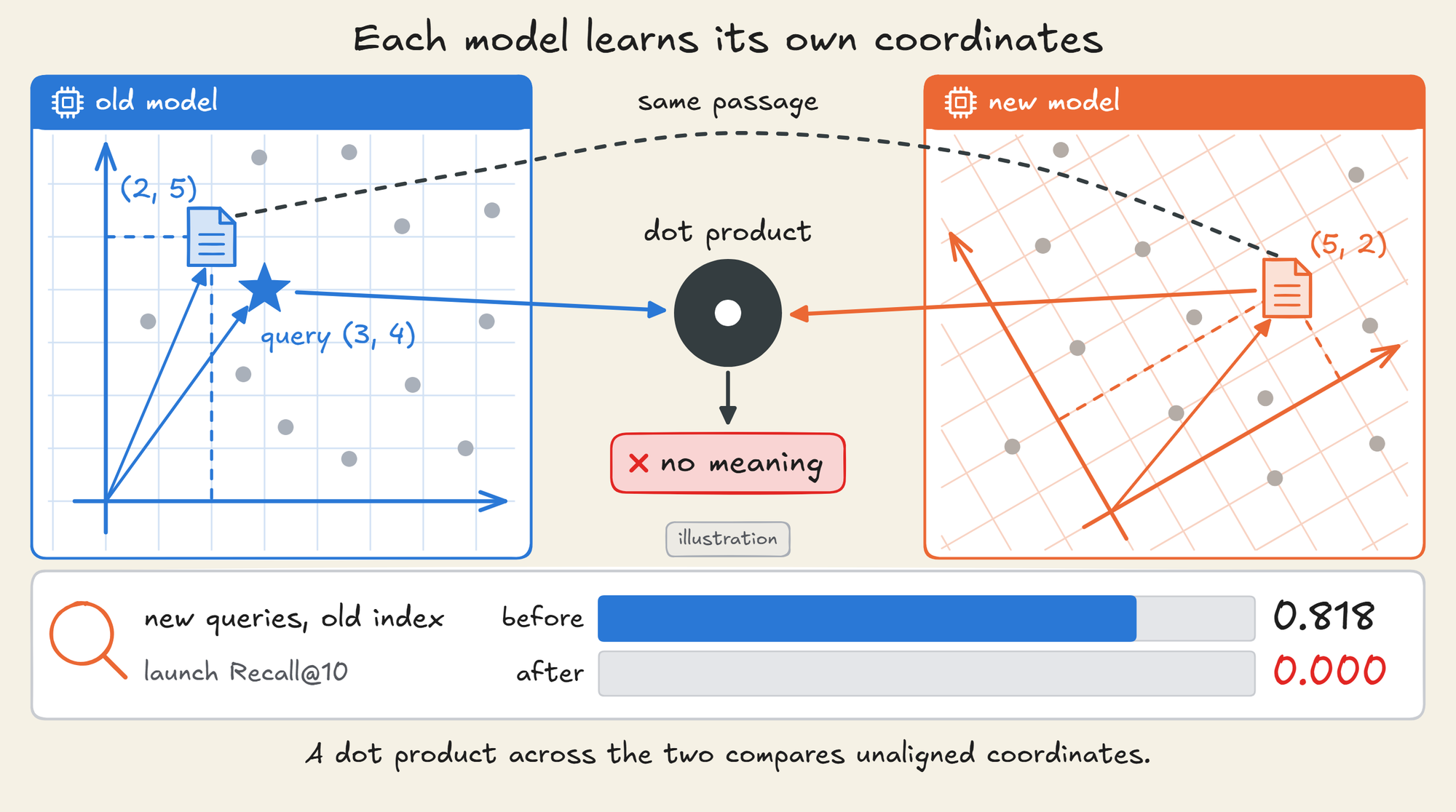
The loud case is the queries moving first. When they moved to the new model before any passage did, Recall@10 on the launch evaluation fell from launch day's 0.818 to 0.000 at once.
The silent case is the reverse, which builds up gradually with nothing on the dashboards to show it. When new and edited pages go in with the new model while the queries stay on the old one, those pages drop out of reach.
Against the six-month mix, over all 5,544 questions of both evaluations, not one top 10 held a passage from the new model.
Every result came from the old part of the index and looked normal.
To catch the mix, every point and every collection carries a stamp of its embedding space, which in this part is the model's name and its commit hash. The write path and the query path both refuse a mismatch.
The stamp names the space, because a model name isn't enough any more.
Voyage AI's Voyage 4 series shares one space across four models: "All four models produce compatible embeddings, meaning embeddings generated from different models can be used interchangeably".
A stamp that names the shared space, with the vector's size and precision, lets those models mix. A stamp of the model name would refuse a mix Voyage says is safe.
What the launch evaluation can and cannot see
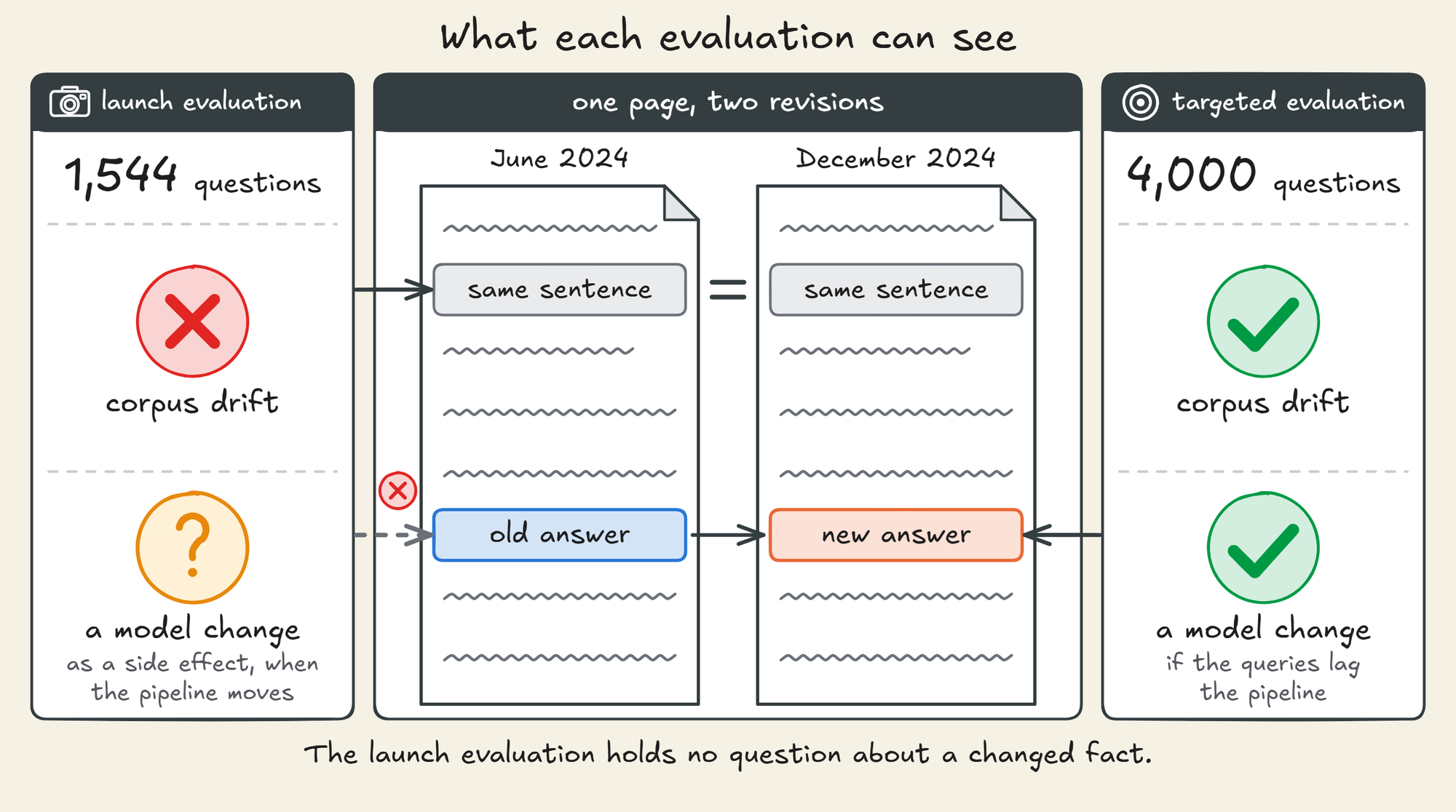
The launch evaluation is built once, from questions whose answers were checked at the time.
It needs questions with one right answer, so it uses facts that were stable when it was made, and most of them stay stable.
That makes it blind to corpus drift. A question whose answer never changed can't show whether the index ranks an outdated revision first.
It sees a model change in the pipeline only as a side effect, when a page is re-embedded for some other edit and the tested fact stays the same. On busy pages, that happens quickly.
A targeted evaluation starts from the other side. It takes facts that changed after launch, with the new answers as gold, and asks whether the index returns the current revision.
A changed fact's new revision enters through the current pipeline, on its current model. So when the queries lag, the targeted evaluation sees both drifts as soon as a changed fact reaches the index.
It has a blind spot of its own. When the queries move first, it reads high, because they can still find the changed facts. So it runs beside the launch evaluation.
Freshness and evaluation are one problem seen from two ends. The index goes stale because the corpus moved, and the launch evaluation misses the staleness because it was built from the corpus before the move.
Measuring rot
Measuring this takes four things: two sets of questions, a corpus to hide their answers in, a rule for when an evaluation notices, and a timeline for when each page moves.
The targeted evaluation needs facts that changed after launch, the evidence for both answers, and the dates of the change.
HoH, a benchmark from ACL 2025, provides them. Its HoH-QAs set pairs each question with its current answer and evidence, and with the earlier answers and their evidence, from Wikipedia's monthly snapshots between June and December 2024.
Llama-3.1-70B-Instruct wrote those questions and answers from that evidence, which HoH copied from Wikipedia. The authors checked a sample of 500 by hand and found 99.2 percent of the answers accurate to their evidence.
We kept a row only when its new answer appeared in its new evidence and its old answer in the old evidence, after normalisation.
From the rows that passed, we kept one question per page and drew 6,000 in HoH's mix of change months.
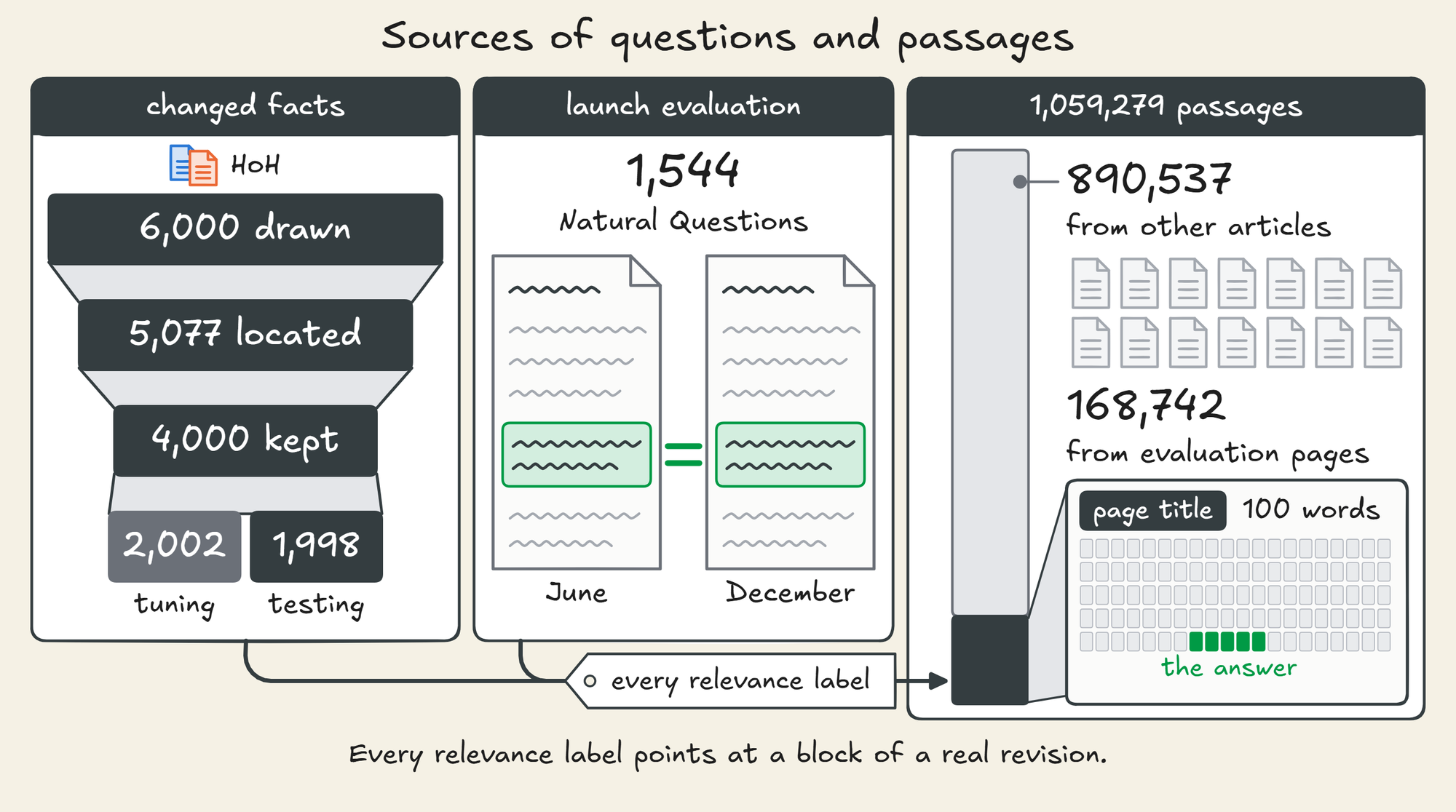
We located the evidence and answers of 5,077 of them in the fetched revisions and took 4,000, split at random into 2,002 for tuning and 1,998 for testing before anything ran.
In all 4,000, the current block holds the new answer and its twin the old one.
The launch evaluation uses 1,544 questions from the Natural Questions development set. They are real Google queries about facts whose sentence was the same in the page's June and December revisions.
People marked those answers on copies of the pages from around 2017 and 2018. For 752 questions the sentence had been reworded since, so we took the launch revision's sentence that holds the marked answer and reads closest to the annotated one.
We built the set with hindsight, keeping only facts that held to December, so it is blinder to corpus drift than a real launch set, whose few changed facts would show up as stale labels.
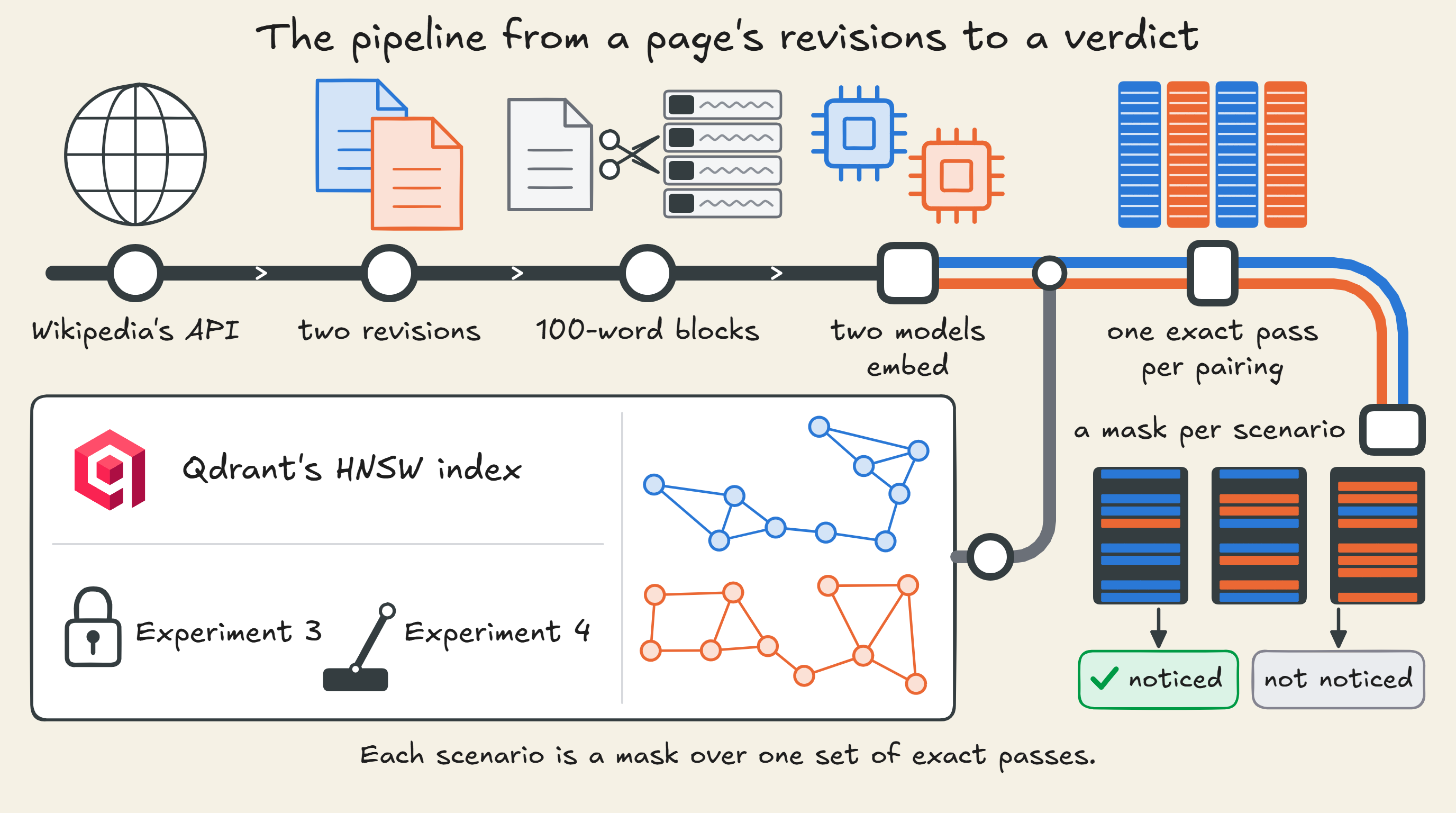
Each passage is a 100-word block, the size DPR (the dense passage retriever) uses, with its page title in front. The corpus holds 1,059,279 of them:
- 168,742 come from the pages behind the two evaluations.
- 890,537 come from other Wikipedia articles and compete with them, as the rest of a corpus does in production.
The relevance labels of both evaluations point into those 168,742 passages.
Both models embed every passage. The old model is granite-embedding-30m-english and the new one granite-embedding-small-english-r2, both with 384 dimensions and both under Apache 2.0.
Experiments 1, 2 and 5 rank by exact search, so no approximate-search error mixes with the drift. Experiments 3 and 4 search Qdrant's HNSW index, as a deployed system does, at the default m of 16 and ef_construct of 100, with hnsw_ef at 128.
Against exact search on the same corpus, that cost the old model 0.3 points of Recall@10 on both evaluations, and the new model 0.1 on the launch evaluation and 0.6 on the targeted one.
Recall@10 is trec_eval's, and MRR@10 is its reciprocal rank on the run cut to 10, both through pytrec_eval.
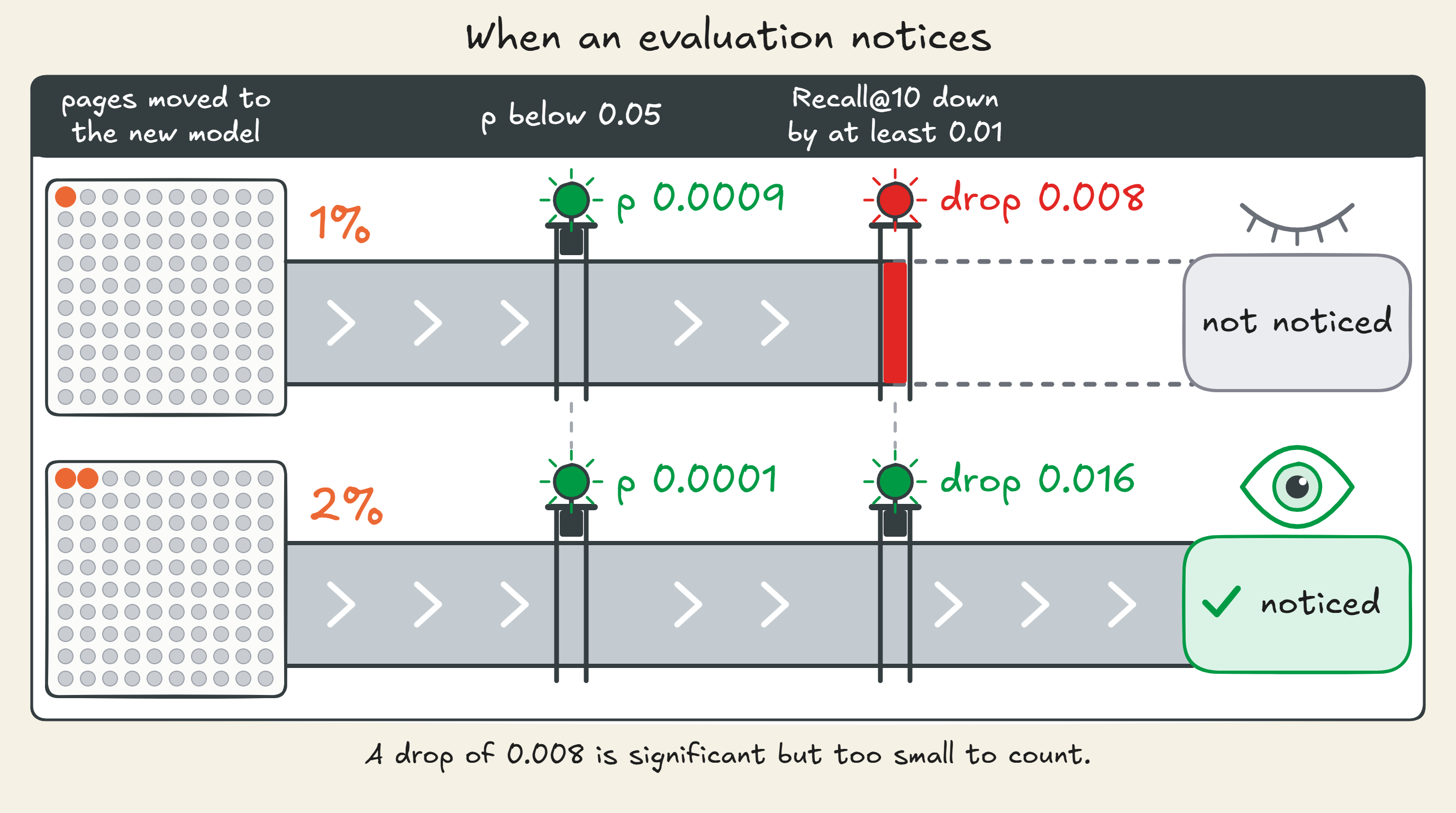
An evaluation notices a drop when both of these hold against launch:
- A paired randomisation test over the same questions gives p below 0.05.
- Recall@10 has fallen by at least 0.01.
The first says a drop this size is unlikely from the questions drawn alone, and the second says it is large enough to act on.
By this rule, the launch evaluation noticed 2 percent of pages moved at random, but not 1 percent:
A smaller set can notice later.
To measure how much later, we drew 200 random sets at each of five sizes from the launch evaluation, 50, 100, 200, 500 and 1,000 questions, once with a fixed seed, and recorded the first week in which at least half of each size noticed.
These sets overlap the full set, so they understate how much a separate set would vary.
The timeline follows real dates. Each HoH page changes in the month HoH records, each launch-evaluation page is re-embedded at its first real edit after launch, and the other pages at seeded random times that follow the edit rate measured on the 2,000 sampled pages.
Hands-on
The steps below build this pipeline:
Setup
To get started, download this particular project zip file and open it in the terminal.