Reinforcement Learning Course
Model-Free Learning
RL Part 4: Learning value functions and policies without a model. Monte Carlo methods, TD(0), SARSA, Q-learning, and the bias-variance bridge between them.

80 posts published
RL Part 4: Learning value functions and policies without a model. Monte Carlo methods, TD(0), SARSA, Q-learning, and the bias-variance bridge between them.
RL Part 3: Bellman expectation and optimality equations, policy iteration, value iteration, and why dynamic programming needs a model.
RL Part 2: Markov decision processes, returns, policies, and value functions.
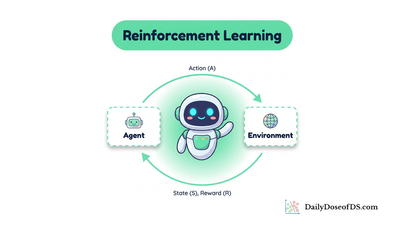
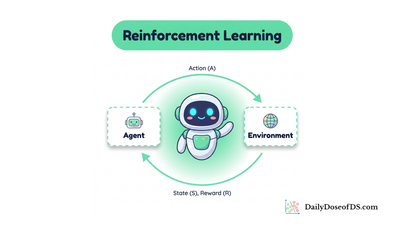
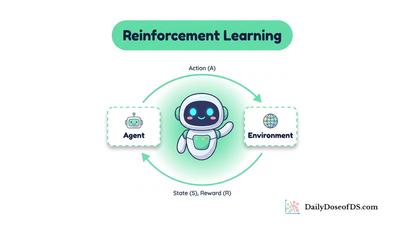
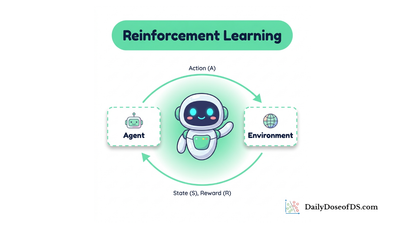
RL Part 1: Agents, environments, rewards, and why RL is different from supervised learning.
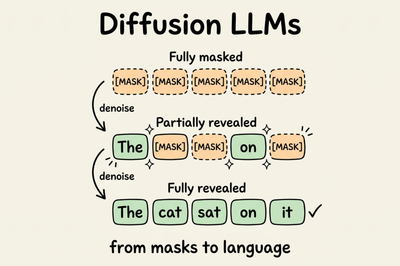
Diffusion LLMs Part 2: How dLLMs scale to 100B parameters, the inference stack that makes them fast, hands-on code, and when to actually use them.
Diffusion LLMs Part 1: Understanding how diffusion language models work from first principles, the math behind masked diffusion, and why they represent a fundamentally different approach to text generation.
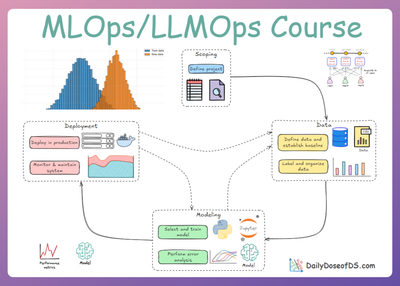
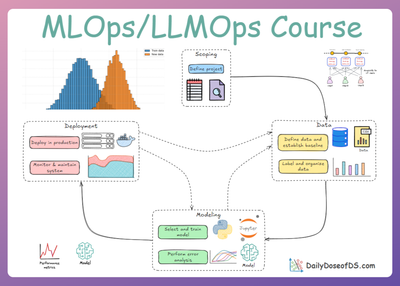
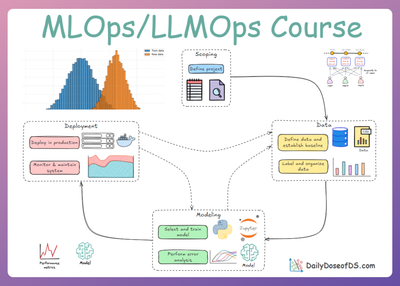
An exploration of real-world MLOps and LLMOps case studies, examining the importance of reliable ML and AI engineering and their significance for business outcomes.
LLMOps Part 14: An overview of the fundamentals of LLM serving, including API-based access, inference with vLLM, and practical decisions.
LLMOps Part 13: Exploring the mechanics of LLM inference, from prefill and decode phases to KV caching, batching, and optimization techniques that improve latency and throughput.
LLMOps Part 12: Understanding LLM fine-tuning, parameter-efficient methods like LoRA and QLoRA, and alignment techniques such as RLHF, DPO, and GRPO.
LLMOps Part 11: Understanding evaluation of conversational LLM systems, tool evaluations, tracing with Langfuse, and automated red teaming.
LLMOps Part 10: Understanding model benchmarks, LLM application evaluation, and tooling.
LLMOps Part 9: A foundational guide to the evaluation of LLM applications, covering challenges and a practical taxonomy of evaluation methods.
LLMOps Part 8: A concise overview of memory, dynamic and temporal context in LLM systems, covering short and long-term memory, dynamic context injection, and some of the common context failure modes in agentic applications.
LLMOps Part 7: A conceptual overview of context engineering, covering context types, context construction principles, and retrieval-centric techniques for building high-signal inputs.
LLMOps Part 6: Exploring prompt versioning, defensive prompting, and techniques such as verbalized sampling, role prompting and more.
LLMOps Part 5: An introduction to prompt engineering (a subset of context engineering), covering prompt types, the prompt development workflow, and key techniques in the field.
LLMOps Part 4: An exploration of key decoding strategies, sampling parameters, and the general lifecycle of LLM-based applications.
LLMOps Part 3: A focused look at the core ideas behind attention mechanism, transformer and mixture-of-experts architectures, and model pretraining and fine-tuning.
LLMOps Part 2: A detailed walkthrough of tokenization, embeddings, and positional representations, building the foundational translation layer that enables LLMs to process and reason over text.
AI Agents Crash Course—Part 17 (with implementation).
AI Agents Crash Course—Part 16 (with implementation).
LLMOps Part 1: An overview of AI engineering and LLMOps, and the core dimensions that define modern AI systems.
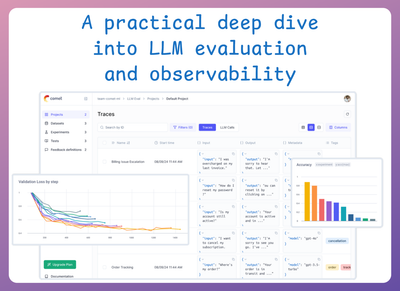
A comprehensive guide to Opik, an open-source LLM evaluation and observability framework.
MLOps Part 18: A hands-on guide to CI/CD in MLOps with DVC, Docker, GitHub Actions, and GitOps-based Kubernetes delivery on Amazon EKS.
MLOps Part 17: ML monitoring in practice with Evidently, Prometheus and Grafana, stitched into a FastAPI inference service with drift reports, metrics scraping, and dashboards.
AI Agents Crash Course—Part 15 (with implementation).
MLOps Part 16: A comprehensive overview of drift detection using statistical techniques, and how logging and observability keep ML systems healthy.
MLOps Part 15: Understanding the EKS lifecycle, getting hands-on with AWS setup, and deploying a simple ML inference service on Amazon EKS.
MLOps Part 14: Understanding AWS cloud platform, and zooming into EKS.