A Practical Deep Dive Into Memory Optimization for Agentic Systems (Part B)
AI Agents Crash Course—Part 16 (with implementation).
410 posts published
AI Agents Crash Course—Part 16 (with implementation).
LLMOps Part 1: An overview of AI engineering and LLMOps, and the core dimensions that define modern AI systems.
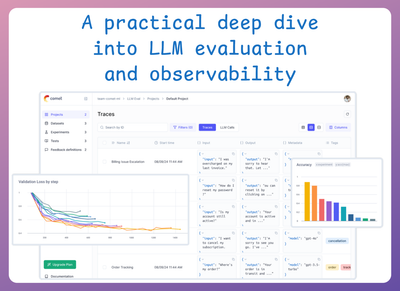
A comprehensive guide to Opik, an open-source LLM evaluation and observability framework.
MLOps Part 18: A hands-on guide to CI/CD in MLOps with DVC, Docker, GitHub Actions, and GitOps-based Kubernetes delivery on Amazon EKS.
MLOps Part 17: ML monitoring in practice with Evidently, Prometheus and Grafana, stitched into a FastAPI inference service with drift reports, metrics scraping, and dashboards.
AI Agents Crash Course—Part 15 (with implementation).
...explained with usage.
MLOps Part 16: A comprehensive overview of drift detection using statistical techniques, and how logging and observability keep ML systems healthy.
MLOps Part 15: Understanding the EKS lifecycle, getting hands-on with AWS setup, and deploying a simple ML inference service on Amazon EKS.
MLOps Part 14: Understanding AWS cloud platform, and zooming into EKS.
...explained step-by-step with code.
Chat with videos and get precise timestamps.
...that actually prevents hallucinations (explained visually).
MLOps Part 13: An overview of cloud concepts that matter, from virtualization and storage choices to VPC, load balancing, identity, and observability.
MLOps Part 12: An introduction to Kubernetes, plus a practical walkthrough of deploying a simple FastAPI inference service using Kubernetes.
Multi-agent (100% local).
Generate realistic data using existing data (100% local).
...with hands-on implementation.
MLOps Part 11: A practical guide to taking models beyond notebooks, exploring serialization formats, containerization, and serving predictions using REST and gRPC.
...explained step-by-step.
100% local.
A unified MCP server for all your data (100% local).
...powered by Qwen 3 LLM.
MLOps Part 10: A comprehensive guide to model compression covering knowledge distillation, low-rank factorization, and quantization, followed by ONNX and ONNX Runtime as the bridge from training frameworks to fast, portable production inference.
MLOps Part 9: A deep dive into model fine-tuning and compression, specifically pruning and related improvements.