Why was MCP created?
Without MCP, adding a new tool or integrating a new model was a headache.
If you had three AI applications and three external tools, you might end up writing nine different integration modules (each AI x each tool) because there was no common standard. This doesn’t scale.
Developers of AI apps were essentially reinventing the wheel each time, and tool providers had to support multiple incompatible APIs to reach different AI platforms.
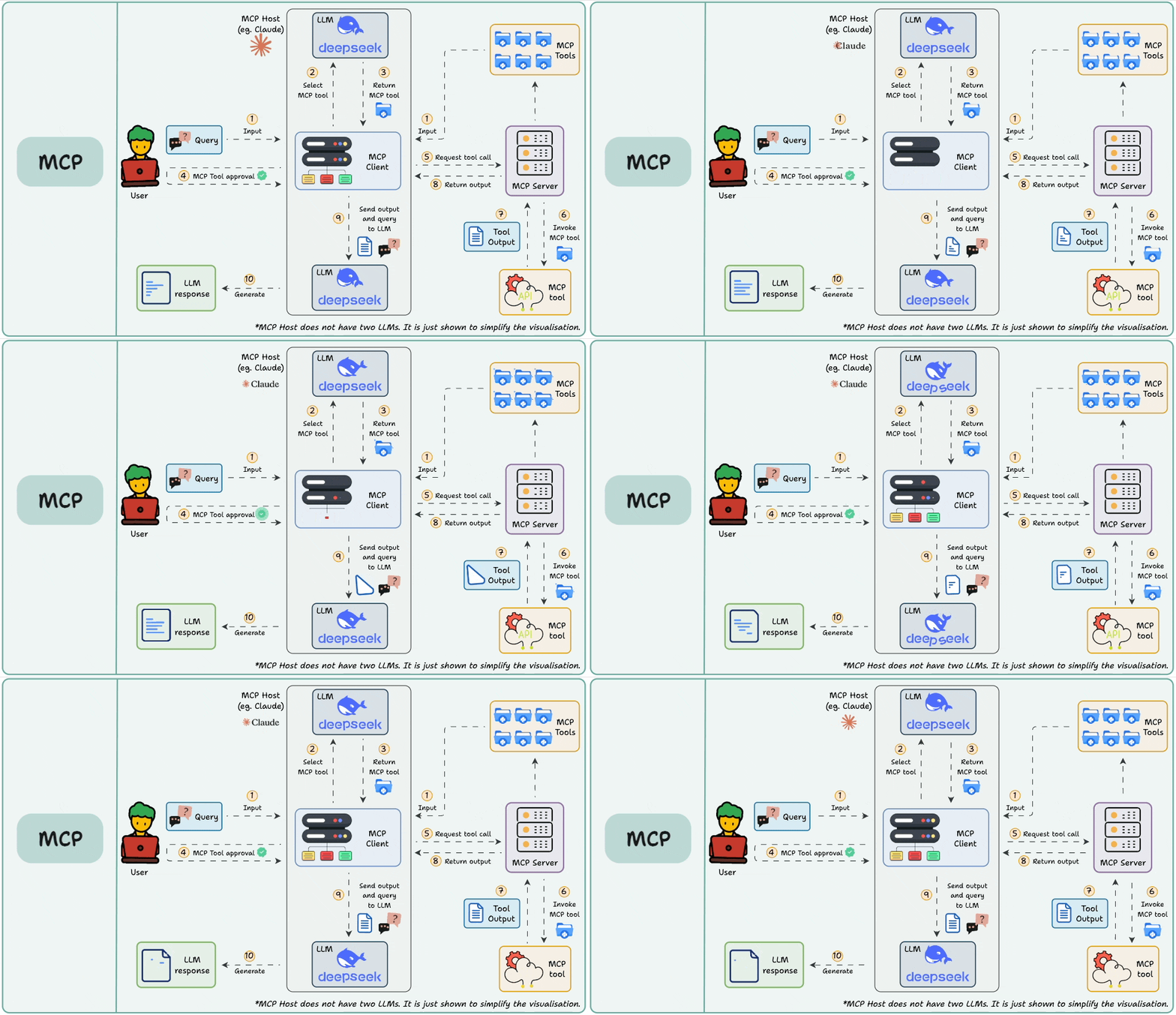
Let’s understand this in detail.
The problem
Before MCP, the landscape of connecting AI to external data and actions looked like a patchwork of one-off solutions.
Either you hard-coded logic for each tool, managed prompt chains that were not robust, or you used vendor-specific plugin frameworks.
This led to the infamous M×N integration problem.
Essentially, if you have M different AI applications and N different tools/data sources, you could end up needing M × N custom integrations.
The diagram below illustrates this complexity: each AI (each “Model”) might require unique code to connect to each external service (database, filesystem, calculator, etc.), leading to spaghetti-like interconnections.

The solution
MCP tackles this by introducing a standard interface in the middle. Instead of M × N direct integrations, we get M + N implementations: each of the M AI applications implements the MCP client side once, and each of the N tools implements an MCP server once.
Now everyone speaks the same “language”, so to speak, and a new pairing doesn’t require custom code since they already understand each other via MCP.
The following diagram illustrates this shift.
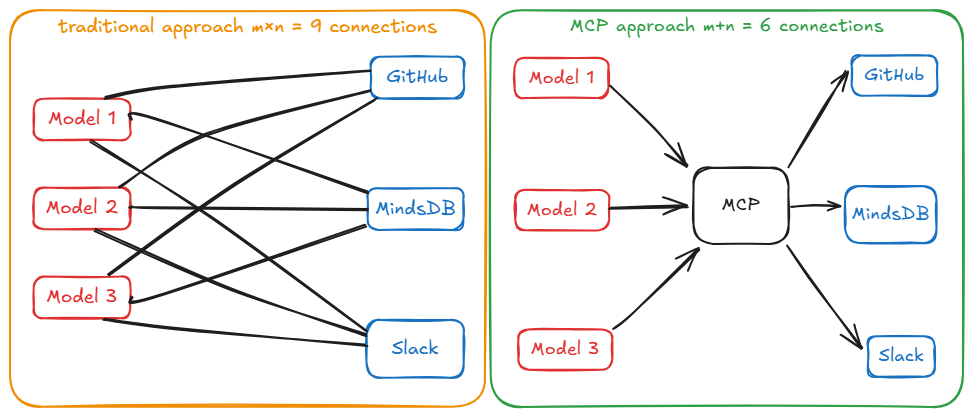
- On the left (pre-MCP), every model had to wire into every tool.
- On the right (with MCP), each model and tool connects to the MCP layer, drastically simplifying connections. You can also relate this to the translator example we discussed earlier.