LLMs
Time Complexity of 10 ML Algorithms
(training and inference)...in a single frame.

Avi Chawla
(training and inference)...in a single frame.
This visual depicts the run-time complexity of the 10 most popular ML algorithms.
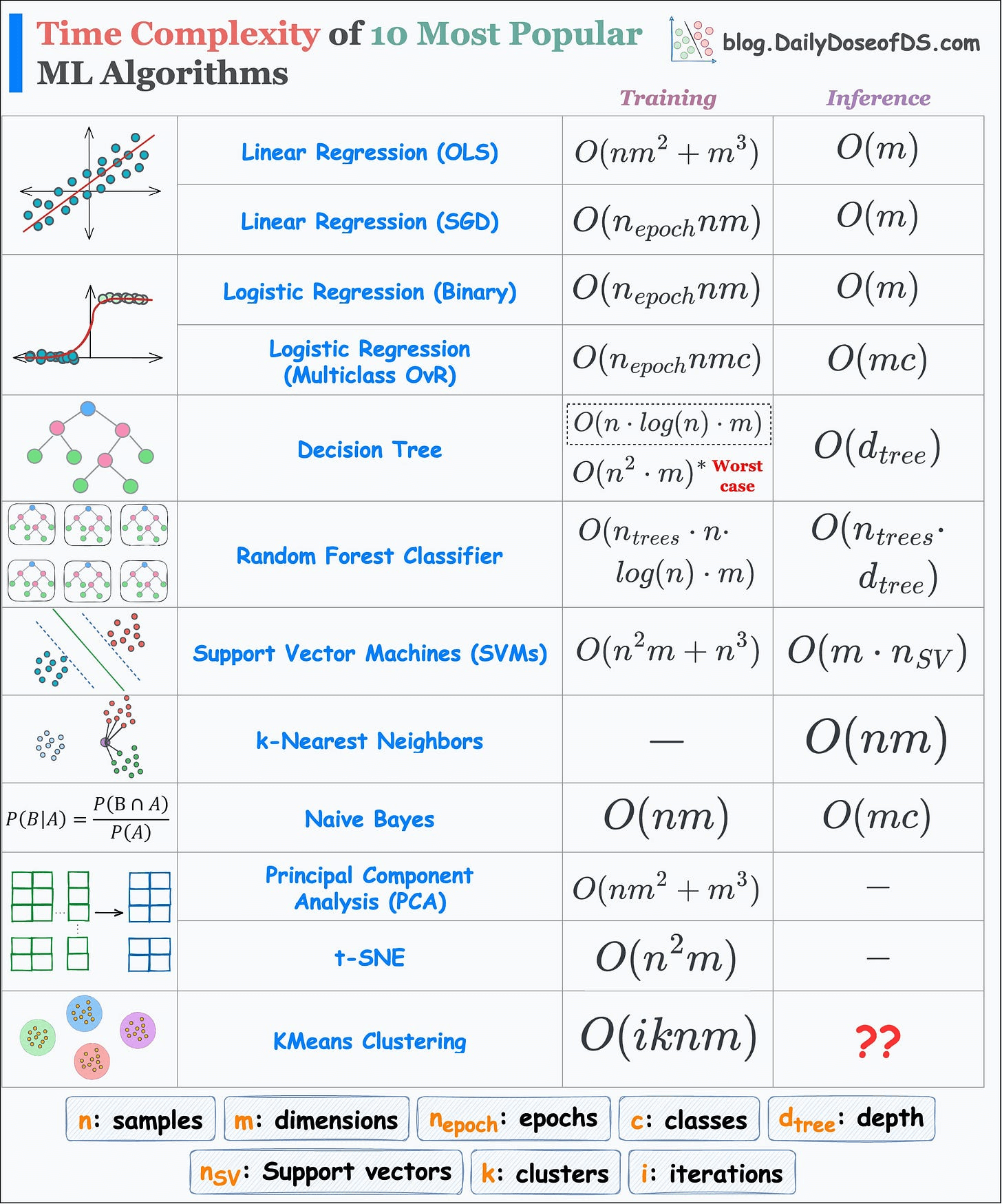
Everyone is a big fan of sklearn implementations.
It takes just two (max three) lines of code to run any ML algorithm with sklearn.
However, due to this simplicity, most people often overlook the core understanding of an algorithm and the data-specific conditions that allow us to use an algorithm.
For instance, you cannot use SVM or t-SNE on a big dataset:
Another advantage of understanding the run-time is that it helps us understand how an algorithm works end-to-end.
That said, we made a few assumptions in the above table:
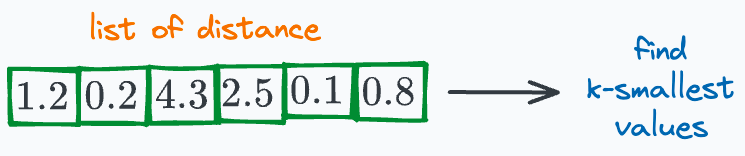
O(nlogn).O(nlog(k)).During inference in kNN, we first find the distance to all data points. This gives a list of distances of size n (total samples).
Today, as an exercise, I would encourage you to derive these run-time complexities yourself.
This activity will give you confidence in algorithmic understanding.
👉 Over to you: Can you tell the inference run-time of KMeans Clustering?
Thanks for reading!